If you’ve been feeling disconnected, losing time, or unsure of your identity, you’re not alone. We offer a sensitive, specialist service to help you make sense of your experience and take the next step at your own pace.
Severe dissociative symptoms can cause disruptions in a person’s memory, consciousness, identity, and sense of self and the world around them. They are often a learned response to traumatic experiences, where dissociation becomes a coping mechanism to distance oneself from overwhelming distress. Symptoms include memory gaps, feeling disconnected from oneself or others, and possibly having distinct identities. Dissociation can be a normal reaction to stress, but in dissociative disorders, it becomes a severe and persistent problem.
Explore the five main symptoms of dissociation – each represented by its own icon and title below. Click on any of the symptoms to learn more about what they mean and how they might be experienced.
Here is an outline of the route that we would follow that might lead to suggesting a full specialist assessment, which a member of our team would be happy to discuss further with you to ensure that this is the right path for you to take at this time.
STEP ONE
Everyone’s experience is different and individual to you. As a next step ask us to send you 2 screening instruments that you can complete and return to us for scoring. They are the DES (Dissociative Experience Scale) and the SDQ20 (Somatoform Dissociative Questionnaire). We will send you a letter outlining the levels of dissociative symptoms and an indication of the likelihood of your having a dissociative disorder. There is no charge for this service.
STEP TWO
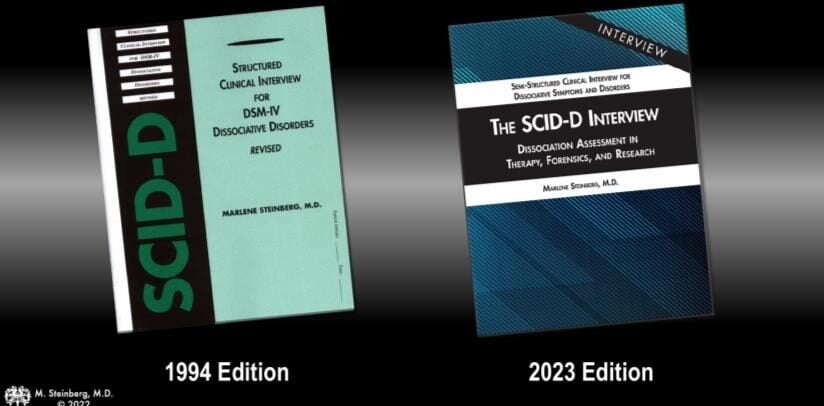
The SCID-D (Semi-Structured Clinical Interview for Dissociative Symptoms and Disorders) assessment.
While screening instruments can give you an indication of the levels of your symptoms it is not a formal diagnosis. We believe it’s important for a number of reasons to consider having a proper diagnosis. These are some of the reasons:-
Though you may accept in theory the possibility of having a dissociative disorder, at another level you may need the validation by having an assessment for this condition.. This may be the first step in getting appropriate treatment for your condition (especially if you are hoping to get help through the NHS). Sometimes Integrated Care Boards (ICBs) or the Psychiatric Services are willing to fund an assessment prior to determining what treatment to offer you. If you are already in therapy (either privately or through the NHS) this may help your therapist focus therapeutically on your difficulties.
STEP THREE
The steps towards having an assessment are as follows:
Completion of the screening instruments.
You will be offered an introductory Zoom call with your assessor, to ensure that the assessment is an appropriate step for you to take. There is no obligation at this point to undergo the assessment, and you are welcome to take the time you need to consider this fully.
The completion of the SCID-D assessment interview, which is carried out in a conversational way, looking at how your symptoms affect you on a day to day basis. We will not be asking any questions about any possible trauma during this time.
Your report is then completed, and you are welcome to give feedback on the draft report, before we complete the report and provide a letter of recommendation for treatment.
Follow up Zoom call, to discuss the outcome of your assessment and treatment recommendations.
The Pottergate Centre has supported individuals and professionals in the field of dissociative disorders for over 40 years. We combine clinical expertise with a responsive, collaborative approach – working nationally with both NHS services and private clinicians.
TESTIMONIALS
What some of our clients have to say
The assessment process with my assessor was an incredibly validating experience. I finally feel like I have an explanation for what’s been happening all my life and a clearer direction for how to move forward….Thank you again for making what could have been a very daunting process feel so supportive and smooth.
Thank you so much for your email, and for the care and thought you put into your reflections following our session…..we really appreciate the way you held space for everything that was shared.
We really are incredibly grateful for the time you gave us in a safe way, and for how you supported everyone who came forward.
I just wanted to say how lovely you are and tell you how much I appreciated the way you were. I don’t have a great memory of the process for that day but my overwhelming memory is of your kindness, supportiveness and understanding.
Pottergate made a potentially difficult decision, full of trepidation, as easy as it could have been made for me and all our learned trauma responses that we had to navigate.
I could not have asked for any better in what you have provided in the reports. Thanks so much to the team for your efforts.
I feel quite calm and accepting of the outcome of my recent SCID-D assessment to be honest and feel I can now finally stop trying to find out what has happened to me after all this time. I just know that this will change my life now as I have a full understanding and I don’t have to keep searching anymore to try to understand myself.
Thank you all so much for all of your help and support during this process, it was a really huge step for me to take but you have made me feel extremely validated throughout this whole process.
Steph made me feel so calm, even in the first Zoom call, it takes an awful lot for me to trust anyone, and I felt at ease straight away which then made taking the next step so much easier for me.
We can send you a set of screening instruments which can then be scored free of charge. For more information, click here. Please complete the contact form to request the screening instrument.
Yes, the SCID-D (Semi-Structured Clinical Interview for Dissociative Symptoms and Disorders) is used to diagnose Dissociative Disorders, and our highly trained team are experts in carrying out the assessment.
Yes, we can offer supervision to help on a regular basis, or as one-off consultations. You are welcome to get in touch to discuss how we can help further.
We can tailor our training packages to work with your individual needs, from introductory courses to carrying out assessments and we would be happy to discuss how we can help you.
Where you may be unable to recall important personal information, usually of a stressful or traumatic nature. This can include;
Forgetting specific events, periods of times, or even aspects of your identity.
Loss of memory for a specific period.
Remembering some, but not all details of an event.
This memory loss cannot be explained by ordinary forgetfulness, and can be the minds’ attempt to cope with overwhelming stress or trauma.
Depersonalisation
Where you may feel detached from yourself, as if you are observing your own thoughts, feelings or body from the outside. It can feel like you are in a dream or watching yourself in a movie. This can include;
Feeling unreal, robotic or emotionally numb.
Sense of being outside of your body or watching yourself from a distance.
Can have a distorted perception of your body size, shape or movement.
Feeling like your thoughts, speak, or actions are not fully your own.
Derealisation
When you may feel detached from your surroundings, or people or the environment.
Where your world may seem dreamlike, blurry, flat, artificial or visually distorted.
Sounds, time or space can feel altered.
People or objects may seem unfamiliar or unreal, even though they are recognised.
Identity Confusion
When you may feel uncertain, conflicted, or puzzled about your own identity. This can include:
Not being sure who you are.
Feeling that there are different sides, selves or identities that don’t fit together.
Confusion about what you may like, believe or value.
Feeling that you are fragmented or your behaviour changes in unexpected ways.
Identity Alteration
When you may demonstrate clear shifts in identity or sense of self which can be accompanied by changes in behaviour, voice, posture, facial expression or attitude. This can include;
Observable changes in your behaviour or mannerisms that appear as if a different person is in control.
Shifts in your voice, vocabulary or body language.
Difference in your skills, preferences or memory.
Memory gaps may accompany these shifts, as one identity may not recall what another identity did. This may be experienced internally or externally if noticed by others.